Klinghardt Detox Support Protocol
Uploaded by
Michael Kao- Klinghardt Detox Support Protocol
Common questions
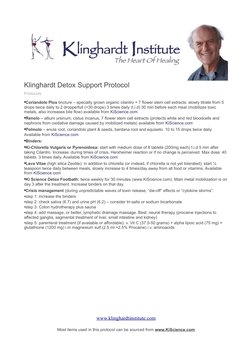
Powered by AILava Vitae, a high silica zeolite product, can be used in addition to or instead of chlorella if chlorella is not tolerated. The dosage starts at ¼ teaspoon twice daily between meals, and is gradually increased up to four times daily, administered away from all food or vitamins .
The Klinghardt Detox Support Protocol recommends using Coriandolo Plus tincture to enhance bile flow, which is crucial for effective detoxification as bile helps in excreting toxins mobilized from body tissues. This tincture, consisting of organic cilantro and flower stem cell extracts, is titrated from 5 drops twice daily to 2 dropperfuls three times daily before meals .
During a Herxheimer reaction, the Klinghardt Detox Support Protocol advises increasing the dose of binders such as Ki-Chlorella or Lava Vitae. This increases the capacity for capturing and removing the surge of toxins mobilized that can potentially worsen symptoms if not adequately managed .
The Ki Science Detox Footbath is used twice weekly for 30 minutes and is strategically designed to stimulate metal mobilization, especially noted on the third day after treatment. On this day, it is recommended to increase binders to maximize the removal of toxins, thus ensuring the detox process is effective and minimizes reabsorption .
Ki-Chlorella Vulgaris or Pyrenoidosa acts as a binder in the Klinghardt Detox Support Protocol, capturing and eliminating mobilized toxins from the body. It is administered starting at 8 tablets (200mg each) three times daily, with the dosage increased during crises or if no change is perceived, up to a maximum of 40 tablets three times daily .
Parenteral treatments in the Klinghardt Detox Support Protocol offer a direct route to enhance detoxification efficacy by bypassing the digestive system. High-dose intravenous Vitamin C, alpha lipoic acid, and glutathione provide potent antioxidant support, reducing oxidative stress while supporting immune function and metabolic pathways for effective cleansing .
Renolo, which includes allium ursinum, cistus incanus, and 7 flower stem cell extracts, is used in the Klinghardt Detox Support Protocol to protect white and red blood cells and nephrons from oxidative damage caused by mobilized metals .
The Klinghardt Detox Support Protocol uses Coriandolo Plus tincture to mobilize toxic metals and increase bile flow, which aids in detoxification by excreting toxins through bile . This mobilization can potentially cause oxidative stress on white and red blood cells and nephrons, which is mitigated by Renolo, another component of the protocol that provides protective benefits to these cells .
The Klinghardt Detox Support Protocol recommends a multi-step approach to managing 'cytokine storms' or 'die-off' effects: 1) increase the binders; 2) check saliva and urine pH and consider tri-salts or sodium bicarbonate; 3) employ colon hydrotherapy and sauna; 4) add massage or lymphatic drainage massage, with neural therapy as a preferred option (procaine injections to affected ganglia); and 5) administer parenteral treatments such as high doses of Vitamin C and alpha lipoic acid .
Neural therapy, including procaine injections to affected ganglia and segmental treatments of the liver, small intestine, and kidney, plays a key role in managing detox-related crises within the Klinghardt Detox Support Protocol. It helps by potentially alleviating the neurological stress and aiding systemic detoxification processes due to its direct impact on the nervous system and targeted organs .