Overview of OSI Model Layers

100% found this document useful (2 votes)
407 views12 pages
The document discusses the OSI model, which is a standard framework for network communication. It describes the seven layers of the OSI model from physical to application layer. Each layer has a specific function, with lower layers dealing with physical connectivity and higher layers focusing on software applications and end users. The physical layer transmits raw bits of data, the data link layer handles framing and addressing, the network layer handles routing and forwarding, the transport layer ensures reliable delivery between endpoints, and the upper layers focus on software applications.

Uploaded by

Gagleen Rissam
License
© All Rights Reserved
We take content rights seriously. If you suspect this is your content, claim it here.
Available Formats
Download as DOCX, PDF, TXT or read online on Scribd
  • OSI Model Overview
  • Functions of OSI Layers
  • Physical Layer
  • Data-Link Layer
  • Network Layer
  • Transport Layer
  • Session Layer
  • Presentation Layer
  • Application Layer

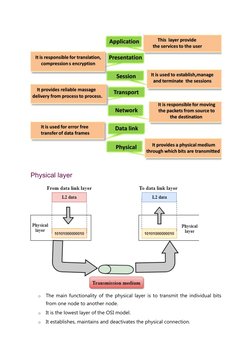
OSI Model

o OSI stands for Open System Interconnection is a reference model that


describes how information from a software

application in one computer

moves through a physical medium to the software application in another


computer.

o OSI consists of seven layers, and each layer performs a particular network
function.
o OSI model was developed by the International Organization for
Standardization (ISO) in 1984, and it is now considered as an architectural
model for the inter-computer communications.
o OSI model divides the whole task into seven smaller and manageable tasks.
Each layer is assigned a particular task.
o Each layer is self-contained, so that task assigned to each layer can be
performed independently.

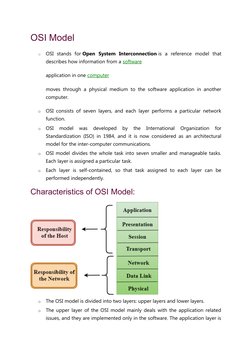
Characteristics of OSI Model:

o The OSI model is divided into two layers: upper layers and lower layers.
o The upper layer of the OSI model mainly deals with the application related
issues, and they are implemented only in the software. The application layer is
closest to the end user. Both the end user and the application layer interact
with the software applications. An upper layer refers to the layer just above
another layer.
o The lower layer of the OSI model deals with the data transport issues. The
data link layer and the physical layer are implemented in hardware and
software. The physical layer is the lowest layer of the OSI model and is closest
to the physical medium. The physical layer is mainly responsible for placing
the information on the physical medium.

Functions of the OSI Layers


There are the seven OSI layers. Each layer has different functions. A list of seven
layers are given below:

1. Physical Layer
2. Data-Link Layer
3. Network Layer
4. Transport Layer
5. Session Layer
6. Presentation Layer
7. Application Layer
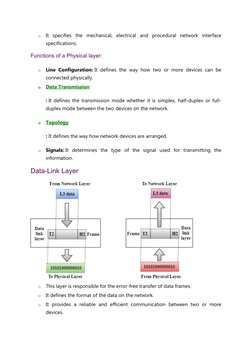
Physical layer

o The main functionality of the physical layer is to transmit the individual bits
from one node to another node.
o It is the lowest layer of the OSI model.
o It establishes, maintains and deactivates the physical connection.
o It specifies the mechanical, electrical and procedural network interface
specifications.

Functions of a Physical layer:

o Line Configuration: It defines the way how two or more devices can be
connected physically.
o Data Transmission

: It defines the transmission mode whether it is simplex, half-duplex or full-


duplex mode between the two devices on the network.

o Topology

: It defines the way how network devices are arranged.

o Signals: It determines the type of the signal used for transmitting the
information.

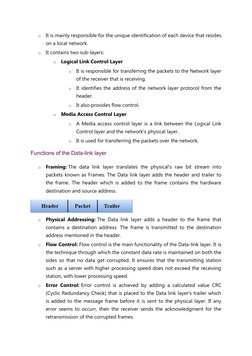
Data-Link Layer

o This layer is responsible for the error-free transfer of data frames.


o It defines the format of the data on the network.
o It provides a reliable and efficient communication between two or more
devices.
o It is mainly responsible for the unique identification of each device that resides
on a local network.
o It contains two sub-layers:
o Logical Link Control Layer
o It is responsible for transferring the packets to the Network layer
of the receiver that is receiving.
o It identifies the address of the network layer protocol from the
header.
o It also provides flow control.
o Media Access Control Layer
o A Media access control layer is a link between the Logical Link
Control layer and the network's physical layer.
o It is used for transferring the packets over the network.

Functions of the Data-link layer

o Framing: The data link layer translates the physical's raw bit stream into
packets known as Frames. The Data link layer adds the header and trailer to
the frame. The header which is added to the frame contains the hardware
destination and source address.

o Physical Addressing: The Data link layer adds a header to the frame that
contains a destination address. The frame is transmitted to the destination
address mentioned in the header.
o Flow Control: Flow control is the main functionality of the Data-link layer. It is
the technique through which the constant data rate is maintained on both the
sides so that no data get corrupted. It ensures that the transmitting station
such as a server with higher processing speed does not exceed the receiving
station, with lower processing speed.
o Error Control: Error control is achieved by adding a calculated value CRC
(Cyclic Redundancy Check) that is placed to the Data link layer's trailer which
is added to the message frame before it is sent to the physical layer. If any
error seems to occurr, then the receiver sends the acknowledgment for the
retransmission of the corrupted frames.
o Access Control: When two or more devices are connected to the same
communication channel, then the data link layer protocols are used to
determine which device has control over the link at a given time.

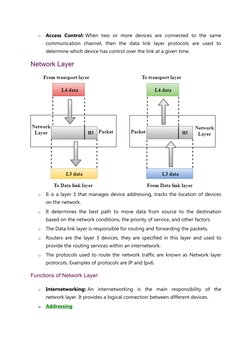
Network Layer

o It is a layer 3 that manages device addressing, tracks the location of devices


on the network.
o It determines the best path to move data from source to the destination
based on the network conditions, the priority of service, and other factors.
o The Data link layer is responsible for routing and forwarding the packets.
o Routers are the layer 3 devices, they are specified in this layer and used to
provide the routing services within an internetwork.
o The protocols used to route the network traffic are known as Network layer
protocols. Examples of protocols are IP and Ipv6.

Functions of Network Layer:

o Internetworking: An internetworking is the main responsibility of the


network layer. It provides a logical connection between different devices.
o Addressing
: A Network layer adds the source and destination address to the header of
the frame. Addressing is used to identify the device on the internet.

o Routing

: Routing is the major component of the network layer, and it determines the
best optimal path out of the multiple paths from source to the destination.

o Packetizing: A Network Layer receives the packets from the upper layer and
converts them into packets. This process is known as Packetizing. It is achieved
by internet protocol (IP).

Transport Layer

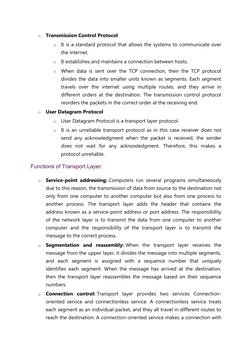
o The Transport layer is a Layer 4 ensures that messages are transmitted in the
order in which they are sent and there is no duplication of data.
o The main responsibility of the transport layer is to transfer the data
completely.
o It receives the data from the upper layer and converts them into smaller units
known as segments.
o This layer can be termed as an end-to-end layer as it provides a point-to-
point connection between source and destination to deliver the data reliably.

The two protocols used in this layer are:


o Transmission Control Protocol
o It is a standard protocol that allows the systems to communicate over
the internet.
o It establishes and maintains a connection between hosts.
o When data is sent over the TCP connection, then the TCP protocol
divides the data into smaller units known as segments. Each segment
travels over the internet using multiple routes, and they arrive in
different orders at the destination. The transmission control protocol
reorders the packets in the correct order at the receiving end.
o User Datagram Protocol
o User Datagram Protocol is a transport layer protocol.
o It is an unreliable transport protocol as in this case receiver does not
send any acknowledgment when the packet is received, the sender
does not wait for any acknowledgment. Therefore, this makes a
protocol unreliable.

Functions of Transport Layer:

o Service-point addressing: Computers run several programs simultaneously


due to this reason, the transmission of data from source to the destination not
only from one computer to another computer but also from one process to
another process. The transport layer adds the header that contains the
address known as a service-point address or port address. The responsibility
of the network layer is to transmit the data from one computer to another
computer and the responsibility of the transport layer is to transmit the
message to the correct process.
o Segmentation and reassembly: When the transport layer receives the
message from the upper layer, it divides the message into multiple segments,
and each segment is assigned with a sequence number that uniquely
identifies each segment. When the message has arrived at the destination,
then the transport layer reassembles the message based on their sequence
numbers.
o Connection control: Transport layer provides two services Connection-
oriented service and connectionless service. A connectionless service treats
each segment as an individual packet, and they all travel in different routes to
reach the destination. A connection-oriented service makes a connection with
the transport layer at the destination machine before delivering the packets. In
connection-oriented service, all the packets travel in the single route.
o Flow control: The transport layer also responsible for flow control but it is
performed end-to-end rather than across a single link.
o Error control: The transport layer is also responsible for Error control. Error
control is performed end-to-end rather than across the single link. The sender
transport layer ensures that message reach at the destination without any
error.

Session Layer

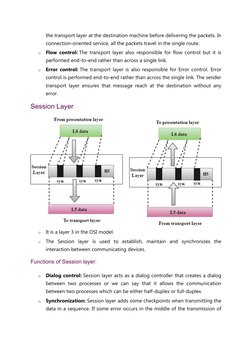
o It is a layer 3 in the OSI model.


o The Session layer is used to establish, maintain and synchronizes the
interaction between communicating devices.

Functions of Session layer:

o Dialog control: Session layer acts as a dialog controller that creates a dialog


between two processes or we can say that it allows the communication
between two processes which can be either half-duplex or full-duplex.
o Synchronization: Session layer adds some checkpoints when transmitting the
data in a sequence. If some error occurs in the middle of the transmission of
data, then the transmission will take place again from the checkpoint. This
process is known as Synchronization and recovery.

Presentation Layer

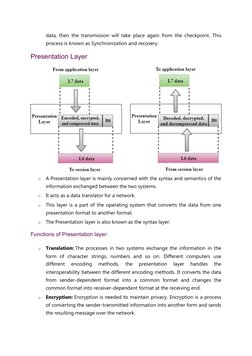
o A Presentation layer is mainly concerned with the syntax and semantics of the
information exchanged between the two systems.
o It acts as a data translator for a network.
o This layer is a part of the operating system that converts the data from one
presentation format to another format.
o The Presentation layer is also known as the syntax layer.

Functions of Presentation layer:

o Translation: The processes in two systems exchange the information in the


form of character strings, numbers and so on. Different computers use
different encoding methods, the presentation layer handles the
interoperability between the different encoding methods. It converts the data
from sender-dependent format into a common format and changes the
common format into receiver-dependent format at the receiving end.
o Encryption: Encryption is needed to maintain privacy. Encryption is a process
of converting the sender-transmitted information into another form and sends
the resulting message over the network.
o Compression: Data compression is a process of compressing the data, i.e., it
reduces the number of bits to be transmitted. Data compression is very
important in multimedia such as text, audio, video.

Application Layer

o An application layer serves as a window for users and application processes to


access network service.
o It handles issues such as network transparency, resource allocation, etc.
o An application layer is not an application, but it performs the application layer
functions.
o This layer provides the network services to the end-users.

Functions of Application layer:

o File transfer, access, and management (FTAM): An application layer allows


a user to access the files in a remote computer, to retrieve the files from a
computer and to manage the files in a remote computer.
o Mail services: An application layer provides the facility for email forwarding
and storage.
o Directory services: An application provides the distributed database sources
and is used to provide that global information about various objects.

Common questions

Powered by AI

The Network layer handles device addressing by adding source and destination addresses to the frame headers, enabling devices to be uniquely identified on the internet. It determines the optimal data path from source to destination through routing, a process involving the selection of the best path from multiple options based on network conditions and priority . This layer uses protocols like IP for routing and forwarding packets, while devices such as routers perform these routing functions .

Connection-oriented services, like TCP, offer high reliability due to their acknowledgment, retransmission, and ordered delivery processes, thus ensuring data integrity but adding overhead through connection setup, maintenance, and error control mechanisms . In contrast, connectionless services, like UDP, minimize overhead by eliminating connection setup and individual packet acknowledgments, enabling faster data transfer at the expense of reliability, as there's no guarantee of packet order or delivery . The choice between these services affects application performance based on the need for speed versus reliability.

In the Data Link layer, flow control is implemented to ensure matching data rates between sender and receiver, avoiding buffer overflow and data corruption on a local link . It utilizes mechanisms specific to local devices and media. Conversely, the Transport layer employs end-to-end flow control to manage data rates between sending and receiving applications across the entire network path. This layer uses techniques such as windowing to control the volume of transmitted data and adjust flow dynamically based on the received acknowledgments .

The Transport layer provides two main services: connection-oriented and connectionless. A connection-oriented service, like TCP, establishes a connection prior to data transfer and ensures reliable, ordered delivery by using sequence numbers for segmentation and reassembly and retransmitting lost segments . In contrast, the connectionless service, like UDP, does not establish a prior connection, treats segments as independent, and lacks reliability guarantees as it doesn't expect acknowledgments for received packets, prioritizing speed over reliability .

Topology, as defined by the Physical layer, determines the arrangement and interconnections of network devices. It influences network design by dictating how signals travel across the network, which can affect performance, scalability, and resilience. Topologies such as star, bus, ring, and mesh dictate the physical layout of cables and devices, influencing aspects like data flow efficiency, fault tolerance, and cost of implementation, ultimately guiding device configuration according to network needs .

The Session layer performs dialog control and synchronization. Dialog control allows the layer to manage and control the conversations between two processes, supporting half-duplex and full-duplex communication modes . Synchronization involves placing checkpoints in data streams to allow error recovery from the last checkpoint, ensuring data integrity and recovery from transmission errors . These functions are critical as they enable controlled, consistent interactions and support error recovery, reducing potential communication disruptions.

The Application layer facilitates user interaction with network services by acting as an interface for users and application processes to access these services. It provides functions for file transfer, access, and management (FTAM), mail services, and directory services, which distribute databases and global information . This layer is important in the OSI model as it supplies necessary services directly impacting the end-user experience and network resource utilization, serving as the connection point between user software and network functions .

The Presentation layer ensures proper data format and security by acting as a data translator. It handles the syntax and semantics of exchanged information, converts data into a common format for transmission, and then into a receiver-dependent format at the destination . Additionally, it provides security services through data encryption, converting information into another form for secure transmission, and compression to reduce data size, crucial for multimedia applications .

The Data Link layer ensures error-free transfer of data frames employing several mechanisms: framing, physical addressing, flow control, error control, and access control. Framing involves translating the physical raw bit stream into packets called frames, with headers containing destination and source addresses. Error control is facilitated through the inclusion of a Cyclic Redundancy Check (CRC) value in the frame's trailer, which allows detection and retransmission of corrupted frames .

The Media Access Control (MAC) sub-layer addresses challenges related to regulating access to the physical transmission medium. It determines which device has permission to transmit data at any given time, a critical function to prevent data collisions in shared communication mediums . The MAC sub-layer ensures coordinated access across multiple devices, maintaining the integrity and efficiency of data transfer in network environments with multiple users, pivotal for shared network functionality .
OSI Model
o
OSI  stands  for Open  System  Interconnection is  a  reference  model  that
describes how information from a sof
closest to the end user. Both the end user and the application layer interact
with the software applications. An upper layer
Physical layer
o
The main functionality of the physical layer is to transmit the individual bits
from one node to another nod
o
It  specifies  the  mechanical,  electrical  and  procedural  network  interface
specifications.
Functions of a Physical la
o
It is mainly responsible for the unique identification of each device that resides
on a local network.
o
It contains two su
o
Access  Control: When  two  or  more  devices  are  connected  to  the  same
communication  channel,  then  the  data  link
: A Network layer adds the source and destination address to the header of
the frame. Addressing is used to identify the devi
o
Transmission Control Protocol
o
It is a standard protocol that allows the systems to communicate over
the internet.
o
It es
the transport layer at the destination machine before delivering the packets. In
connection-oriented service, all the packets
data, then the transmission will take place again from the checkpoint. This
process is known as Synchronization and recovery.

You might also like