COURAGE IS NOT THE ABSENCE OF
FEAR BUT TRIUMPH OVER IT
INTRODUCTION:
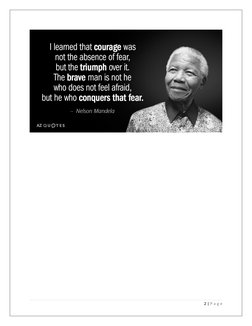
"Courage is not the absence of fear but triumph over it" is a
powerful and widely quoted statement that conveys the idea
that true courage is not the absence of fear, but rather the
ability to face and overcome fear. This quote is often attributed
to Nelson Mandela, the former President of South Africa and a
renowned anti-apartheid revolutionary, but it is important to
note that the exact wording may vary in different sources. The
essence of this quote is that being courageous doesn't mean
you never feel fear; rather, it means that you confront your
fears and continue to act in spite of them. Courage is the
strength to persevere and make the right choices, even when
you are afraid. It's a valuable reminder that fear is a natural
human emotion, and it is our response to fear that defines our
courage and determination.
1|Page
�2|Page
�ORIGIN OF THE QUOTES:
The quote "Courage is not the absence of fear, but rather the
assessment that something else is more important than fear" is
attributed to Nelson Mandela. This quote is often associated
with the former President of South Africa and anti-apartheid
revolutionary Nelson Mandela, who was a key figure in the
struggle against apartheid and later became a global symbol of
resistance to oppression and injustice. However, it's important
to note that the exact wording and phrasing of quotes can
sometimes vary in different sources, so you may find slightly
different versions of this quote.
3|Page
�COURAGE – A CHOICE TO ACT:
Courage is indeed a choice to act, often in the face of fear,
adversity, or uncertainty. It's the willingness to confront
difficult situations, take risks, and stand up for one's beliefs or
values, even when it might be challenging or uncomfortable.
Courage is not the absence of fear; rather, it's the ability to
move forward despite that fear. It can manifest in various
forms, such as:
[Link] Courage: Taking a stand for what is right, just, or
ethical, even when it's unpopular or difficult.
[Link] Courage: Facing physical danger or hardship, like
first responders and soldiers do in their line of duty.
[Link] Courage: Being open and vulnerable about one's
feelings and experiences, even when it feels uncomfortable or
risky.
[Link] Courage: having a consciousness of the need
to face and fairly address ideas, beliefs or viewpoints
toward which one has strong negative emotions and to
which one has not given a serious hearing.
4|Page
�WHAT CAN ONE LEARN FROM FEAR:
Fear can be a powerful teacher and source of personal growth.
Here are some things one can learn from fear:
[Link]-awareness: Fear often brings to the surface our deepest
insecurities, doubts, and vulnerabilities. It can teach us about
our own limitations and the areas where we need personal
growth.
[Link] and resilience: Confronting fear can teach us about
our ability to face adversity and overcome challenges. It can
build resilience and inner strength as we learn to cope with and
move through fear.
[Link] assessment: Fear can help us evaluate risks and make
better decisions. It prompts us to consider the potential
consequences of our actions and can guide us in making more
informed choices.
[Link]-solving: Fear often presents problems or obstacles
that we must address. It can stimulate our problem-solving
skills and creativity as we seek solutions to mitigate or
eliminate the source of fear.
[Link]: Fear can be a natural response to change, and it
teaches us the importance of adaptability. Learning to adapt to
5|Page
�new situations or uncertainties can help us grow and thrive in
different circumstances.
[Link] and emotional regulation: Fear often elicits
strong emotions. Learning to manage these emotions through
practices like mindfulness can lead to better emotional
regulation and overall well-being.
[Link]: Fear can help us clarify our priorities. It forces
us to consider what truly matters to us, helping us focus on
what is most important in our lives.
8. Growth and personal development: Overcoming fear often
requires personal growth and development. It can push us to
learn new skills, gain knowledge, and become a stronger, more
resilient individual.
9. Appreciation: Facing fear can lead to a greater appreciation
for the things we might take for granted in our lives.
It's important to note that while fear can be a valuable teacher,
it should not paralyze or control one's life. Managing and
confronting fear in a healthy way is essential for personal
growth and well-being. In some cases, seeking support from
friends, family, or a mental health professional may be
necessary to navigate and learn from fear effectively.
6|Page
�BENEFITS OF HAVING COURAGE OVER FEAR:
Courage and fear are two contrasting emotions or states of
mind, and there are several benefits to having courage over
succumbing to fear:
[Link] Growth: Confronting fears with courage can lead to
personal growth and development. It pushes you out of your
comfort zone, allowing you to learn, adapt, and become a
stronger, more resilient individual.
[Link] Goals: Courage is often a key factor in achieving
your goals. It gives you the determination and fortitude to
pursue your dreams, even when faced with obstacles and
setbacks.
[Link] Confidence: Each time you act with courage, it
boosts your self-confidence. Overcoming fear reinforces the
belief that you can handle difficult situations, which, in turn,
helps you tackle future challenges with greater confidence.
[Link] Resilience: Courage helps you build emotional
resilience, enabling you to cope with stress, anxiety, and
adversity. It allows you to better manage your emotions and
maintain composure in tough situations.
7|Page
�[Link] Others: Demonstrating courage can inspire others
to do the same. Your actions can serve as an example to those
around you, encouraging them to face their fears and pursue
their goals.
[Link] Change: Courage is often the catalyst for positive
change. It can lead to groundbreaking innovations, social
progress, and improved relationships, as it encourages
individuals to speak out, stand up for what they believe in, and
challenge the status quo.
[Link] Fear: By confronting fear, you often have the
opportunity to understand and overcome the underlying causes
of that fear. This can lead to personal healing and growth.
It's important to note that courage doesn't mean being
fearless; rather, it's about acknowledging your fears and
choosing to act despite them. In many cases, the presence of
fear is what makes acts of courage significant and meaningful.
8|Page
�HOW AND WHY TO OVERCOME FEAR :
Overcoming fear is a common human challenge, and it can be
achieved through a combination of understanding, mindset
shifts, and practical strategies. Fear can manifest in various
forms, including fear of failure, fear of the unknown, fear of
rejection, and fear of physical danger. Here are some steps to
help you overcome fear:
Identify the Fear: The first step in overcoming fear is to
identify and define it clearly. What exactly are you afraid of?
Understanding the root cause of your fear is crucial.
Understand the Fear : Try to understand where the fear
comes from and whether it is rational or irrational. Sometimes,
fear is based on misconceptions or past experiences that may
no longer be relevant.
Challenge Negative Thoughts :Often, fear is fueled by
negative thoughts and beliefs. Challenge these thoughts and
replace them with more positive and rational ones. This can be
done through techniques like cognitive behavioral therapy
(CBT).
Set Realistic Goals: If your fear is related to a specific task or
goal, break it down into smaller, manageable steps. Achieving
9|Page
�these smaller goals can build your confidence and help you
overcome the fear.
Seek Support: Talk to friends, family, or a therapist about
your fears. Sharing your fears with someone you trust can
provide emotional support and valuable perspectives.
Visualization: Use visualization techniques to imagine
yourself successfully facing and conquering your fear. This can
help build confidence and reduce anxiety.
Take Action: Often, the best way to overcome fear is to
confront it. Gradual exposure to the source of your fear can
help you desensitize and adapt to it.
Learn from Failure: Recognize that failure is a part of life, and
it doesn't define your worth. Each failure is an opportunity to
learn and grow. Embrace it as a chance for personal
development.
Stay Persistent: Overcoming fear is often a gradual process,
and it may require time and effort. Stay persistent and
committed to working on it.
10 | P a g e
�FIGHTING AGAINST FEAR IS HARD BUT WORTH IT :
Public Speaking: Many people fear public speaking, but facing
this fear can lead to improved communication skills and career
opportunities. Overcoming the fear of speaking in front of an
audience can be challenging, but it's worth it in terms of
personal and professional development.
Traveling Alone: Traveling to a foreign country alone can be
intimidating, as it involves navigating unfamiliar places and
cultures. Conquering the fear of solo travel can lead to personal
growth, selfdiscovery, and memorable experiences that you
wouldn't have had otherwise.
Confronting a Phobia: Many people have phobias, such as a
fear of heights, spiders, or flying. Facing these fears through
therapy or gradual exposure can be difficult, but it can lead to a
significant improvement in the quality of life and reduced
anxiety.
Relationships: Fear of rejection or vulnerability can hinder the
formation of deep, meaningful relationships. Confronting these
fears and opening up to others can lead to rewarding and
fulfilling connections.
11 | P a g e
� Educational Pursuits: Going back to school or pursuing higher
education as an adult can be scary due to the fear of not fitting
in or failing academically. However, the personal and career
growth that can result from further education often outweighs
the initial fear.
Health and Fitness: Overcoming the fear of physical
challenges and discomfort can lead to improved health and
well-being. Whether it's starting a new exercise routine or
changing your diet, conquering fear can result in a healthier
and happier life.
Creative Expression: Many individuals fear expressing their
creative ideas due to self-doubt or fear of criticism. Pushing
through this fear can lead to the creation of meaningful art,
music, or writing, which can be personally fulfilling and even
connect with others.
In all these examples, while overcoming fear is challenging, the
personal growth, new experiences, and potential rewards make
it a worthwhile endeavor. It's important to recognize and
manage fear in a healthy way rather than allowing it to control
your decisions and limit your potential.
12 | P a g e
�SOME OF MY WORST FEARS AND HOW I
MANAGED THEM
Fear of Public Speaking:
1. Practice: The more you practice, the more confident you
become. Join clubs or take courses to improve your public
speaking skills.
2. Visualization: Visualize yourself successfully delivering a
speech to boost your confidence.
3. Breathing exercises: Deep breaths can help calm your
nerves before speaking.
Fear of Heights (Acrophobia):
1. Exposure therapy: Gradual exposure to heights can help
reduce anxiety. Start with small heights and work your way up.
2. Seek professional help: A therapist can help you address the
root causes of your fear.
Fear of Flying (Aviophobia):
1. Education: Learning about the safety of air travel and how
planes work can reduce fear.
2. Relaxation techniques: Deep breathing, meditation, or
mindfulness exercises can help manage anxiety during flights.
13 | P a g e
�3. Medication: Consult a doctor for medication options that can
help ease anxiety while flying.
Fear of Failure:
1. Reframe your thinking: Instead of viewing failure as a
negative outcome, see it as a learning opportunity.
2. Set realistic goals: Break down big goals into smaller,
achievable steps.
3. Self-compassion: Be kind to yourself and avoid harsh self-
criticism.
It's important to remember that overcoming fears often takes
time and effort. Professional help from therapists, counselors,
or psychologists can be very beneficial in addressing deep-
seated fears and phobias. Additionally, understanding the root
causes of your fears can be a crucial step in the process of
overcoming them.
14 | P a g e
�FAMOUS PERSONALITIES WHO OVERCAME THEIR
FEAR :
Oprah Winfrey: Oprah has spoken about her fear of failure
and how she overcame it to become one of the most successful
media personalities in the world. Her speeches and interviews
often touch on this topic.
J.K. Rowling: The famous author of the Harry Potter series has
talked about her struggles with poverty and depression and
how she used her fear as motivation to write one of the most
successful book series of all time.
15 | P a g e
� Will Smith: Will Smith is known for his motivational speeches
and talks about facing his fears. He often discusses how he
overcame fear to achieve his goals and become a successful
actor and musician.
Ellen DeGeneres: Ellen DeGeneres has talked openly about
her fear of coming out as gay in the entertainment industry.
Her courage and honesty in facing this fear has been a source
of inspiration for many.
16 | P a g e
�BIBLIOGRAPHY:
[Link]
[Link]
[Link]
17 | P a g e
�THANK
YOU!
18 | P a g e