Comparing Kamikaze and Exposure Themes
Uploaded by
anna.kennerley- Kamikaze vs Exposure Analysis
Common questions
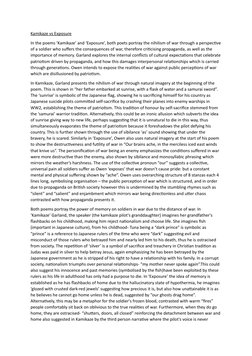
Powered by AIGarland in 'Kamikaze' explores memory through the kamikaze pilot’s flashbacks induced by reminders of his childhood like fish, which symbolize cultural significance and personal past . This memory leads him to reject nationalism, but his return results in ostracism from his family, illustrating the conflict between personal memory and cultural expectations . Owen in 'Exposure' portrays memory in a more painful light, with soldiers' flashbacks to home being shadowed by the impossibility of return, as illustrated by 'our ghosts drag home' and the unwelcoming imagery of 'shutters, doors, all closed' .
Both poems employ natural imagery to convey the nihilism of war and its impact on soldiers. In 'Kamikaze', Garland uses the image of sunrise, which symbolizes the Japanese flag, to illustrate the theme of patriotism and sacrifice . However, this natural imagery is ironic, as it subverts the idea of a new life beginning . Owen, in 'Exposure', uses personification with 'the merciless iced east winds that knive us' to reflect the destructiveness of war . This suggests that nature itself is an adversary, emphasizing the futility of conflict .
In 'Kamikaze', cultural tradition, exemplified by the samurai code, heavily influences the pilot's initial commitment to a suicide mission as an act of patriotism . The poem's structure, with its rigid stanzas representing societal control, and imagery like 'a flask of water and a samurai sword,' underscores this indoctrination . Garland critiques this through the contrast of free verse and enjambment, symbolizing the pilot's eventual rejection of such traditions, emphasizing the unnaturalness of sacrificing personal desires and relationships for national ideals .
Garland uses shifts in narrative perspective in 'Kamikaze' by employing the voice of the pilot's granddaughter, which highlights the generational impact of his rejection of patriotic suicide and the ostracism faced as a result of his decision . This perspective provides depth to the familial and societal disconnection brought by war ideals. Owen maintains a collective first-person perspective in 'Exposure' to convey a shared, universal soldier experience, deepening the futility and enduring suffering of war, seen in 'our brains ache' . Both poets effectively use perspective to underscore war's intangible legacy on personal and collective levels .
Garland uses free verse and enjambment in 'Kamikaze' to signify the pilot's rejection of rigid social codes and traditions that pressure individuals into self-sacrifice for their nation . The use of six lines per stanza represents the rigid control of governmental and societal expectations . Conversely, Owen employs a rigid structure with eight stanzas, each four lines long, symbolizing societal perceptions of order in war due to propaganda. However, the chaos and disorder of war are mirrored through stumbling rhymes and enjambment .
Garland shows in 'Kamikaze' how war impacts interpersonal relationships severely; the pilot's return leads to his ostracism, even from his family, symbolized by 'my mother never spoke again' . This reflects societal values that prioritize nationalism over family bonds . Owen's 'Exposure' addresses soldier's societal alienation, with memories of home becoming unattainable due to the war's traumatic impact, as seen in 'our ghosts drag home' . Both poets critique the societal perceptions warped by propaganda; however, while Garland focuses on personal familial disconnection, Owen emphasizes the broader communal alienation and painful memory of home .
Garland in 'Kamikaze' uses imagery such as 'dark prince' to reflect the internal conflict and betrayal felt by the pilot, illustrating a cultural and familial separation initiated by his refusal to comply with war demands . His imagery of fish and the sea suggest nostalgia and a return to innocence, adding a dual sense of peace and loss . Owen in 'Exposure', however, employs harsh language with phrases like 'our brains ache' and 'merciless iced east winds that knive us', emphasizing unrelenting physical and mental torment instigated by war . Both poets highlight psychological impacts through language that contrasts nostalgia with harsh realities, critiquing war's pervasive mental scars .
Garland explores betrayal in 'Kamikaze' through the pilot's experience, where his family's rejection post-abandonment of his mission reflects a deep-seated cultural betrayal, as indicated by 'my mother never spoke again,' emphasizing nationalism over kinship . This theme is further symbolized by 'silver', linking to betrayal in Christian tradition . Owen's 'Exposure' subtly weaves national betrayal as societal expectations entrap soldiers in futile war efforts against nature's wrath, alienating them from the comforts of home . Both poems encapsulate betrayal within personal and national scopes, critiquing propagandist expectations that fracture natural human ties .
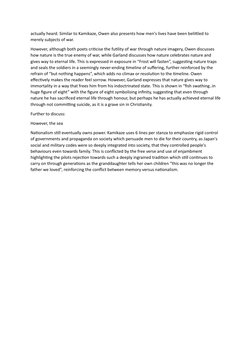
Garland in 'Kamikaze' portrays nature symbolically as a refuge and a reminder of life's continuity and beauty, opposed to the finality of the pilot's mission. The 'fish swathing... in huge figure of eight' suggests infinity and a life beyond nationalist confines . Owen in 'Exposure' approaches nature as a menacing force, with 'Frost will fasten' portraying the relentless cruelty of war, exacerbated by nature's indifference to human conflict . Each poet critiques propaganda's romanticized war narrative: Garland through nostalgia and rejection, Owen through pervasive nature-induced suffering .
In 'Kamikaze', Garland uses the sunrise as a symbol of Japanese national identity and patriotism, linking it to the kamikaze tradition of self-sacrifice for the country's honor . Yet, this symbolically foreshadows the pilot's defiance, suggesting the surreal irony and ultimate futility of such indoctrination . Owen's 'Exposure' utilizes symbolism through the harsh elements, representing the futility and chaos of war overshadowing nationalist glorification, challenging societal propaganda that glorifies war . Both poets use national symbols to critique the destructive consequences of conflating identity with nationalism .